
We’ve all been there. You spend hours meticulously crafting a mix in your home studio, bouncing the track and playing it in your car, only to find the bass is completely overwhelming and the vocals are buried. Alternatively, you take your favourite, most comfortable studio cans to a live DJ gig, but the moment you put them on, you can’t hear your cue track over the club’s PA system.
Why does this happen? Because when it comes to audio, a headphone is not just a headphone.
Whether you are cueing up a techno track in a deafening club booth or delicately EQing a vocal in a quiet room, the tool you need changes drastically. Studio headphones are designed to tell you the brutal truth about your audio, while DJ headphones are built for isolation, durability and high sound pressure levels (SPL).
In this deep dive, we are going to settle the ultimate debate of closed back vs open back designs, compare legendary models like the DT 770 and Beyerdynamic DT 990 Pro, look at top competitor models we stock at DY Pro Audio and give you professional tips on how to properly test your next pair of monitor headphones.
The Big Debate: Closed Back vs Open Back
Before you look at brand names, you must understand the physics of headphone construction. The back of the headphone ear cup dictates how air and sound waves behave, which completely alters the listening experience.
Closed-Back Headphones (The DJ & Tracking Standard)
As the name suggests, the outer casing of the ear cup is completely sealed with solid plastic, metal, or wood.
-
The Physics: Because the ear cup is sealed, sound cannot escape into the room and external noise cannot get in. This provides "passive isolation."
-
The Pros: Incredible isolation. If you are a DJ standing next to a 2,000-watt monitor speaker, closed-back headphones block out the stage noise so you can actually hear the track you are beat-matching. In the studio, a vocalist uses closed-back headphones so the click track doesn't bleed into the recording microphone.
-
The Cons: Because the sound waves have nowhere to go, they bounce off the inside of the sealed plastic cup. This can create a build-up of low-frequency energy, making the bass sound artificially punchy or "boomy," which isn't always accurate for critical mixing.
Open-Back Headphones (The Mixing & Mastering Legend)
Open-back headphones have an exposed outer casing, usually covered by a metal grille or mesh.
-
The Physics: Air and sound waves pass freely right through the ear cup.
-
The Pros: Because there is no solid barrier for the sound to bounce off, you get zero internal resonance. This creates a beautifully flat, accurate frequency response and a massive, wide "soundstage." It sounds like you are listening to premium studio monitors in a treated room rather than having speakers strapped to your skull.
-
The Cons: They offer zero isolation. Everyone in the room will hear what you are listening to and you will hear every footstep, fan noise and conversation around you. If you take open-back headphones to a DJ gig, they are completely useless.
The Beyerdynamic Heavyweights
When discussing monitor headphones, one German manufacturer dominates the conversation. Let’s look at two industry titans that sit on opposite sides of the closed/open spectrum.
The Closed-Back King: Beyerdynamic DT 770 Pro
Walk into any radio broadcasting station, recording studio, tracking room, or professional podcast setup in the UK and you will likely see a pair of DT 770 headphones.
-
The Design: Closed-back, over-ear design. They feature incredibly comfortable silver velour ear pads that allow you to wear them for a five-hour session without experiencing "sweaty ear" fatigue.
-
The Sound: For a closed-back headphone, the soundstage is surprisingly wide. They are famous for a slight "V-shape" EQ curve, meaning they have deep, analytical bass and very crisp, articulate highs.
-
The Verdict: The DT 770 is the ultimate all-rounder. You can track vocals, edit podcasts and, yes, even DJ with them (provided you don't mind the non-detachable cable and larger form factor).
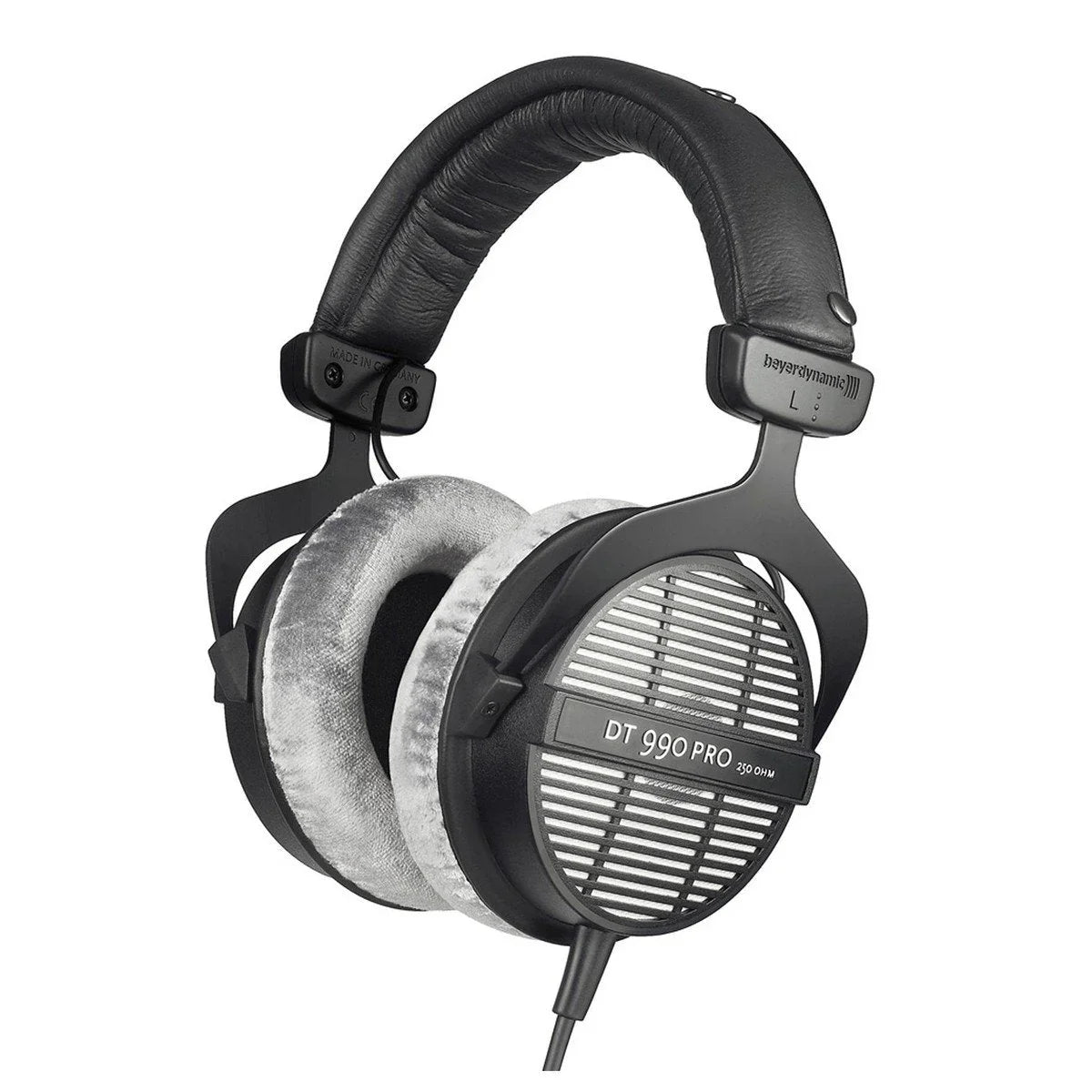
The Open-Back Legend: Beyerdynamic DT 990 Pro
If your primary goal is mixing and mastering music in a quiet room, the DT 990 Pro is widely considered the best performance-to-value ratio on the market.
-
The Design: Open-back, over-ear. Like its sibling, it features plush velour pads and a robust metal headband.
-
The Sound: Because it is open-back, the bass is incredibly precise. It doesn't artificially boost the low-end; it tells you exactly what is there. The Beyerdynamic DT 990 Pro is also known for its brilliant (sometimes aggressive) high-frequency response. If there is a harsh, piercing hi-hat in your mix, the DT 990 Pro will expose it instantly, forcing you to fix it.
-
The Verdict: The definitive tool for home studio producers who cannot rely on their room acoustics. They force you to mix better.
A Crucial Technical Insight: Understanding Impedance (Ohms)
Both of these Beyerdynamic models come in different impedance ratings (typically 32 Ohm, 80 Ohm and 250 Ohm).
-
32 Ohm: Perfect for mobile phones, laptops and basic DJ controllers without powerful amplifiers.
-
80 Ohm: The sweet spot. Great for audio interfaces (like a Focusrite Scarlett) and professional DJ mixers.
-
250 Ohm: These require serious voltage to push the drivers. If you plug 250 Ohm headphones directly into an iPad or a cheap mixer, they will sound incredibly quiet and thin. You must use a dedicated headphone amplifier or a high-end audio interface.
The Competitors: What Else Should You Consider?
While the Beyerdynamic line is legendary, it might not suit everyone's specific workflow. Here are the top alternatives we frequently recommend at DY Pro Audio.
1. The Indestructible DJ Standard: Sennheiser HD25
If you are purely a DJ, the Beyerdynamic models might feel too bulky. Enter the Sennheiser HD25.
-
The Profile: These are on-ear (supra-aural) closed-back headphones.
-
The Pros: They are incredibly lightweight and the iconic split-headband ensures they clamp securely to your head while you are jumping around the booth. Every single part (cable, ear pads, headband) is easily replaceable. Furthermore, they boast a massive SPL rating, and they can handle deafening club volumes without distorting.
2. The Modular Innovator: AIAIAI TMA-2 Studio XE
If you are looking for a modern, future-proof alternative to traditional studio headphones, the AIAIAI TMA-2 Studio XE is a revelation for producers and tracking engineers.
-
The Profile: Closed-back, over-ear.
-
The Pros: Their biggest selling point is their fully modular design, if a cable snaps or you want to upgrade an ear pad, you simply replace that single component instead of buying a whole new pair. At just 190 grams, they are exceptionally lightweight, preventing neck fatigue during marathon studio sessions.
Sonically, they utilise rigid bio-cellulose drivers that deliver a highly detailed, punchy low-end, making them a massive favourite for electronic, dance, and hip-hop producers.
3. The Premium DJ Option: Pioneer DJ HDJ-X10
For the touring club DJ who demands absolute pristine sound, the flagship Pioneer DJ model is hard to beat.
-
The Profile: Closed-back, over-ear.
-
The Pros: Built to military standard shock testing, these are rugged. They also feature nano-coated ear pads to resist sweat and grime. Sonically, they offer an astonishing frequency response (5 Hz to 40,000 Hz), ensuring you hear every sub-bass rumble and high-hat sizzle over the club system.
Listening Tests: How to Evaluate Monitor Headphones
When you buy a new pair of studio headphones, you need to train your ears to understand their specific "voice."
-
Use Uncompressed Audio: Do not test your new headphones using a compressed YouTube stream or standard Spotify. Use high-resolution WAV or FLAC files, or at the very least, ensure your streaming service is set to the highest audio quality.
-
The Reference Track: Pick three songs that you know intimately. You should know exactly how the bass should feel, where the vocal sits and how wide the stereo image is. Listen to these tracks repeatedly on your new headphones.
-
The Sweep Test: Listen for any frequency "bumps." Does the bass guitar suddenly jump in volume on certain notes? This will help you understand the frequency curve of your headphones so you can compensate when mixing.
-
Allow for Adjustment: There is a long-standing debate about "burning in" headphones (leaving them playing pink noise for 50 hours to loosen the drivers). While the mechanical benefits are debated, mental burnout is real. Your brain needs time to adjust to the new, highly detailed sound profile.
Conclusion
Choosing between the DT 770, the Beyerdynamic DT 990 Pro and competitors like the HD25 comes down to a simple question: Where are you going to use them?
If you are a mobile DJ or a vocalist in front of a live microphone, a closed-back model like the DT 770 or Sennheiser HD25 is mandatory. If you are a producer sitting in a quiet room trying to perfect a mixdown, the open-back transparency of the DT 990 Pro is unmatched.
At DY Pro Audio, we believe that audio is subjective. You can read specifications all day, but nothing beats putting them on your head. If you are stuck deciding between closed back vs open back, visit our Kent showroom. You can plug these models directly into our demo mixers and interfaces, play your own reference tracks and find the perfect fit for your workflow.

