
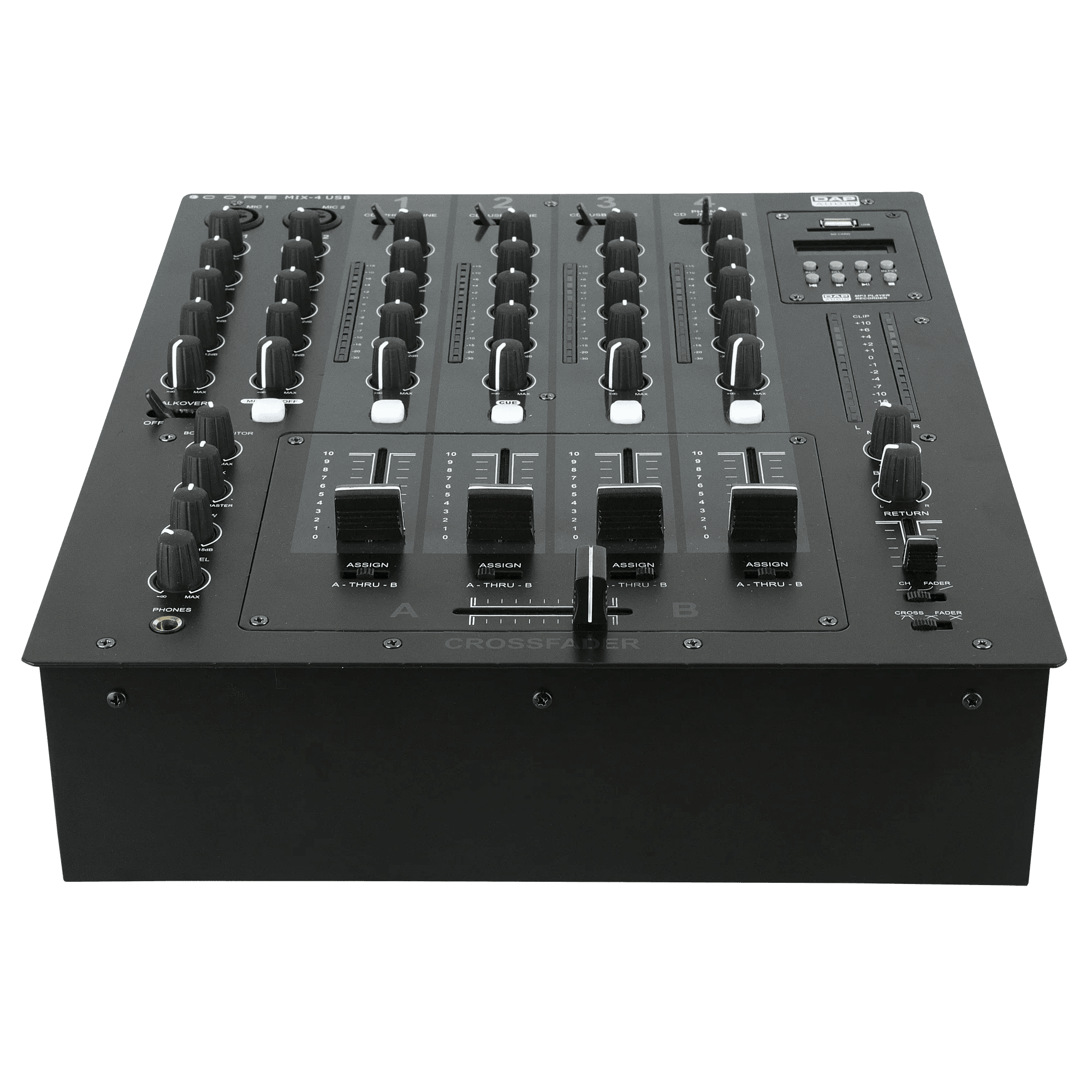
In the world of pro audio equipment, the word "mixer" is a broad umbrella term. While every mixer performs the same fundamental task, taking multiple audio signals, combining them and sending them to your speakers, the way they achieve this drastically changes depending on the application.
Trying to mix a live five-piece rock band on a DJ mixer is a fast track to a terrible-sounding gig. Conversely, trying to perform a flawless club DJ set on a live mixing desk is incredibly frustrating and mechanically awkward.
Whether you are a mobile DJ upgrading your rig, a venue owner outfitting a new stage, or a musician building a rehearsal space, buying the wrong gear is an expensive mistake. In this guide, we are breaking down the technical differences between a DJ mixer, a live mixing desk and a mixer amplifier, so you can invest in the right nerve centre for your audio setup.
1. The DJ Mixer: The Art of the Blend
A DJ mixer is specifically designed for playing pre-recorded music. Its primary job is to allow the DJ to seamlessly transition (blend) between two or more stereo tracks playing from CDJs, turntables, or DJ software.
The Technical Insight: Because DJs deal with finished, mastered stereo tracks, the architecture of a DJ mixer is completely different to a live desk.
-
Inputs: They feature RCA (Phono) inputs specifically designed with RIAA preamps to amplify the tiny signal from vinyl turntables.
-
The Cue System: This is the most critical feature. A DJ mixer allows you to listen to Channel 2 in your headphones while the audience hears Channel 1 through the main speakers. Without this, beatmatching is impossible.
-
The Crossfader: A horizontal slider that allows you to fade track A out while simultaneously fading track B in with a single hand movement.
The Solution & Product Fit: If you are a mobile DJ, club resident, or scratch artist, this is your tool.
-
For the ultimate club-standard experience, the Pioneer DJM-V10 is a 6-channel behemoth that offers studio-quality 64-bit mixing, dedicated compressors on every channel and complex routing for external FX. It is the gold standard for festival stages.
-
If you want premium sound quality in a slightly more accessible format, the new AlphaTheta DJM-V5 offers a brilliantly smooth crossfader and pristine audio, making it perfect for both home setups and professional mobile rigs.
2. The Mixing Desk: The Live Sound Command Centre
A mixing desk (often called a PA mixer or mixing console) is designed for live music and events. Instead of blending two stereo songs, its job is to balance dozens of individual mono sources, like three vocal microphones, a kick drum, a bass guitar and a keyboard.
The Technical Insight: Live sound is raw and unpolished. A mixing desk gives you the surgical tools to fix problems before they hit the speakers.
-
Microphone Preamps: They feature multiple XLR inputs with high-gain preamps to boost quiet microphones. They also provide +48V Phantom Power to run condenser microphones and active DI boxes.
-
Auxiliary Sends (Aux): In a live band, the singer needs to hear themselves over the drummer. An Aux send allows you to create a completely separate, custom mix for the singer and send it to a monitor speaker on the stage, without affecting what the audience hears out front.
-
Parametric EQ: Unlike a DJ mixer, a DJ mixing desk for live sound features "sweepable mids." If a snare drum sounds "boxy" at 400Hz, you can target that exact frequency and cut it.
The Solution & Product Fit: If you run a live music venue, manage a function band, or host panel talks with multiple microphones, you need a live desk.
-
The Allen & Heath ZED60-10FX is a brilliant, highly respected analogue desk. It gives you 4 premium microphone preamps, built-in high-quality studio effects (reverbs/delays) and an incredibly warm EQ section.
-
For smaller acoustic duos or podcasters on a budget, the Soundsation MIOMIX 202M is a fantastic 4-channel audio mixer that even includes built-in Bluetooth for playing backing tracks straight from your phone.
3. The Mixer Amplifier: The All-In-One Powerhouse
To understand a mixer amplifier, you must remember the golden rule of PA systems: A mixer only processes the signal; it does not power the speakers. Usually, you send the mixer's signal to Active speakers (which have amps built in) or to a separate heavy-duty amplifier rack.
A mixer amplifier combines a mixing desk and a power amplifier into one single chassis.
-
The Technical Insight: These units take the hassle out of wiring. You plug your microphones into the front and run thick Speakon or Jack speaker cables from the back directly into Passive speakers.
-
100V Line vs Low Impedance: You will often see mixer amps designed for "100V line" systems. This is an installation standard used in churches, shops and large venues that allows you to daisy-chain dozens of ceiling speakers together over massive distances without losing volume or blowing the amp.
The Solution & Product Fit: Mixer amps are perfect for permanent venue installations, fitness instructors, or old-school passive PA rigs where simplicity is key.
-
For commercial installations (like a cafe or pub), the Clever Acoustics MA 160 100v 60w Mixer Amplifier is the industry standard. It handles multiple zones, paging microphones and background music effortlessly.
-
For a portable, traditional passive PA setup, the Pulse PMH200 Mixer Amplifier (200W) gives you an incredibly simple, rugged all-in-one box to drive a pair of passive top speakers for a small hall or rehearsal room.
Feature Head-to-Head: EQ & Routing
To truly understand which unit you need, look at how they handle equalisation (EQ) and routing.
The EQ Philosophy
-
DJ Mixers use "Isolators." If you turn the bass knob all the way down on a Pioneer DJM, it completely kills the bass frequencies. This is a creative performance tool, allowing the DJ to swap the bassline of one track with another.
-
Mixing Desks use "Surgical EQ." If you turn the bass knob down on an Allen & Heath desk, it only reduces the bass by roughly 15dB. It is designed to gently correct the tone of a vocalist or instrument, not completely mute the frequency.
The Routing Philosophy
-
DJ Mixers are Simple: Everything goes to the Master Out (the audience) and the Booth Out (your DJ monitors).
-
Mixing Desks are Complex: A signal can go to the Master, to Subgroups (grouping all drum mics onto one fader), to multiple Stage Monitors (Aux 1, Aux 2) and out to external hardware effects racks.
Quick Comparison: Which Mixer is Right for You?
If you are still weighing your options, use this technical cheat sheet to quickly identify which piece of gear matches your workflow.
|
Feature |
DJ Mixer |
Mixing Desk (Live Console) |
Mixer Amplifier |
|
Primary Use Case |
Blending pre-recorded stereo tracks seamlessly. |
Balancing multiple live mono sound sources. |
Simple all-in-one mixing and powering of passive speakers. |
|
Primary Inputs |
RCA (Phono for turntables, Line for CDJs). |
XLR (with Mic Preamps) and ¼ Inch Jack. |
Mixed (XLR, Jack, RCA). |
|
EQ Style |
Isolator EQ: Designed to completely "kill" frequency bands for creative transitions. |
Surgical EQ: Often features sweepable mids to fix problematic frequencies in live vocals/instruments. |
Basic EQ: Usually simple Treble and Bass controls for overall tone shaping. |
|
Headphone Cueing |
Essential: Allows you to preview the next track before the audience hears it. |
Secondary: PFL (Pre-Fade Listen) exists to check levels, but isn't used for beatmatching. |
Rare: Usually not included or necessary for standard installations. |
|
Output to Speakers |
Line Level signal (Requires Active Speakers or a separate Power Amplifier). |
Line Level signal (Requires Active Speakers or a separate Power Amplifier). |
High Voltage / Powered (Connects directly to Passive Speakers via Speakon/Bare Wire). |
|
Best Suited For |
Club residents, scratch artists and mobile DJs. |
Function bands, acoustic duos, theatres and panel talks. |
Pub/restaurant installations, fitness instructors and rehearsal rooms. |
|
DY Pro Audio Pick |
AlphaTheta DJM-V5 |
Allen & Heath ZED60-10FX |
Clever Acoustics MA 160 |
Conclusion: Which Setup is Right for You?
Choosing between a DJ mixer, a mixing desk and a mixer amplifier ultimately comes down to your primary sound source.
If you are manipulating stereo tracks, scratching and need to cue songs in your headphones, the DJ mixer is your undisputed weapon of choice. If you are balancing a stage full of microphones and live instruments, the surgical precision of a live mixing desk is mandatory. And if you are wiring up a pub with passive ceiling speakers and need reliable, background power, the mixer amplifier is the neatest solution.
Still not sure which route to take? That is exactly what we are here for. Whether you need the flagship AlphaTheta DJ mixer for your club or a Clever Acoustics amp for your restaurant, contact us or visit us in-store. We’ll help you spec the exact piece of pro audio equipment to make your rig sound flawless.

